Presence Is Our Provision
In the span of a week, I’ve sat at a coffee table playing games with friends, a church fellowship hall adorned with plastic folding tables celebrating my grandmother’s 90th birthday, and gathered around a formal dining room table with several ladies for our first small group Bible study for the season.
While each table and event was vastly different, each one was marked by the same thing: presence.
Presence has the power to transform ordinary tables into extraordinary means of connection.
Photo by Krišjānis Kazaks on Unsplash
However, we also know the opposite can happen when presence is missing or absent. We’ve all felt that deep longing and ache when someone is no longer able to be with us—longing for the days of old, and yearning to be together again.
This longing and desire for connection is also a picture of the Lord’s heart for his people throughout the Old and New Testament. The gospel tells us the great lengths God has gone through for his people to once again have access to his presence and be seated at his table with him.
To better understand God’s longing and desire for relationship and fellowship, it’s important to go back to the beginning to see how he’s been orchestrating reconciliation between himself and mankind.
The Divine Host
In Genesis 1, God’s generous hospitality is on display. He has created this beautiful dwelling place for himself and mankind, and the first guests he’s invited into his garden—the Garden of Eden—are Adam and Eve. Before their arrival, he makes sure the garden has everything imaginable they may need including an abundance of food and water. The only thing not included
on the menu is the Tree of the Knowledge of Good and Evil. Besides not eating from that specific tree, the only thing God requires on their part is to steward the land. Adam and Eve are able to enjoy walking and talking with God as much as they desire in this divine sanctuary God has created for them.
However, due to their disobedience to God’s command to not eat of the Tree of the Knowledge of Good and Evil, they were cast out of the Garden of Eden and cut off from God’s presence (Genesis 3). We often glaze over that reality, but it’s important to really stop and think for a minute how it must have felt.
Just as we can feel the absence of someone’s presence, how much deeper was the ache and longing in their hearts—and God’s—when they were separated from one another?
It had to be excruciatingly painful to go from always being with God to feeling the weight of sin and the separation.
But God—being so hospitable—has always had a plan for his people to be reconciled to him and in relationship with one another.
God extends a divine invitation to Israel at Mount Sinai making a covenant with them to be set apart from the world as his chosen people, who would also be dedicated to serving the Lord as a kingdom of priests and a holy nation (Exodus 19). To establish a meeting place between God and his people, he gives the Israelites detailed instructions on how to build the tabernacle.
Hosting the Presence
The tabernacle was a place, or symbol, where divine hospitality wouldn’t just be initiated by God, but where the Israelites would learn how to host and steward God’s presence. Skilled craftsmen were filled with the Spirit of God in wisdom, understanding and knowledge in how to build the tabernacle and its furnishings (Exodus 31).
The furnishings outside of the tabernacle were created as a way for priests to make daily atonement for sin for themselves and others, and become ceremonially clean before entering into the tabernacle. This consisted of:
· The Altar of Burnt Offerings—located outside the tabernacle—where priests made daily sacrifices and offerings, and sprinkled the blood from animal sacrifices on the altar for others, as well as themselves (Exodus 27:1-8). The reason sacrifices had to be made was innocent blood had to be shed for the guilty—it’s how atonement, or paying the price for sin, could be made. It did not remove the sin completely, but it covered their sins, so the priests could minister before the Lord.
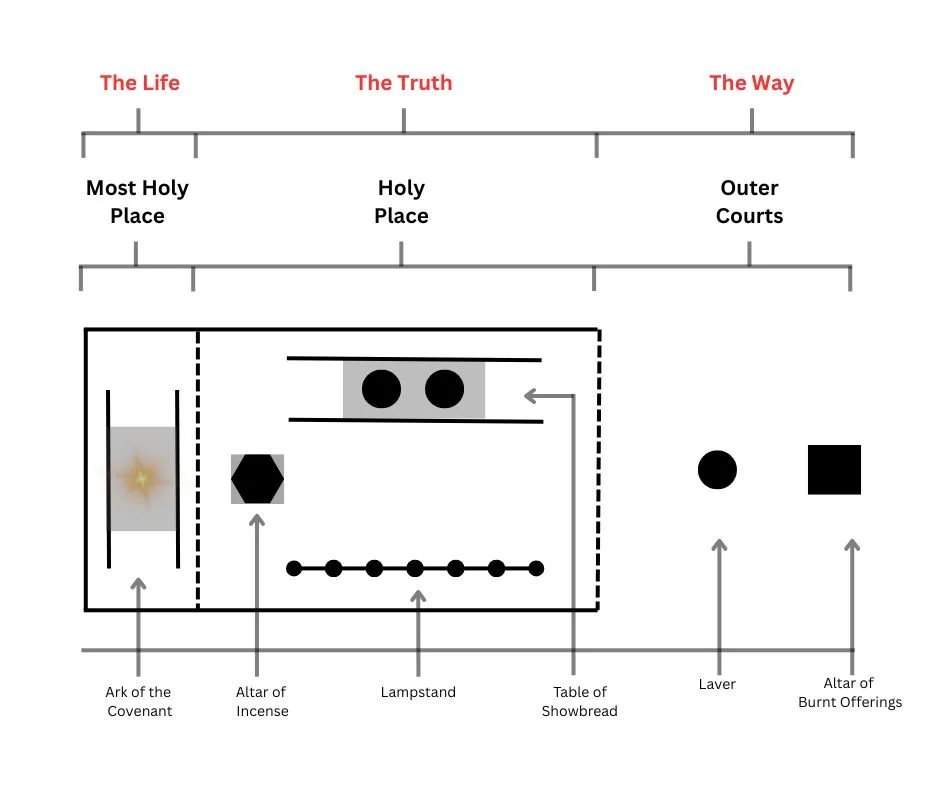
· The Laver—located between the altar of burnt offerings and the entrance to the tabernacle—where priests washed their hands and feet from the basin of water to prepare for service in the tabernacle. If they did not do this, they would be ceremonially unclean, and would ultimately die if they tried to enter the Holy Place before becoming clean (Exodus 30:19-20, Exodus 40:32).
The Holy Place was the first section of the tabernacle, and it was where the priests entered daily [1]. They went into the Holy Place to make offerings every morning and evening. The furnishings in the Holy Place were a symbol, or reminder of God’s presence, which consisted of:
· The Lampstand—located in the Holy Place standing opposite the table of showbread—it had seven lamps and bowls to be lit, illuminating the inside of the tabernacle (Exodus 25:31-40). The priests tended to the lamp daily to ensure it was continually burning (Leviticus 24:1-4).
· The Table of Showbread—locatedin the Holy Place opposite the gold lampstand—is where offerings were placed on the table, and it also always had 12 loaves of bread sitting on the table representing the 12 tribes of Israel (Exodus 25:23-30). The priests baked the showbread. Every Sabbath they would replace it with fresh bread, and ate the removed bread while in the Holy Place (Leviticus 24:5-9)
· Altar of Incense—located in the Holy Place and in front of the veil—is where incense burned on the altar, creating a sweet-smelling aroma before God (Exodus 30:1-10). The priests walked between the gold lampstand and the table of showbread to bring an offering before God.
On the other side of the altar of incense, there was a veil—or floor-length curtain—separating the Holy Place from the Most Holy Place. The Most Holy Place contained the ark of the covenant (or testimony). It was symbolic for the dwelling of God’s presence on earth as it is in heaven, but it had restricted access:
· The Ark of the Covenant—located in the Most Holy Place and behind the veil— was where the Ten Commandments—or law—were kept, but it could only be accessed once a year by the high priest on the Day of Atonement (Exodus 25:10-22). The high priest sprinkled blood on the ark of the covenant as a sin offering for himself, as well as the sins for the nation of Israel (Leviticus 16).
Not all of the Israelites could enter the tabernacle for worship, it was only for the Levitical Priesthood, who were selected from the tribe of Levi—one of the twelve tribes of Israel. The priests made the offerings on behalf of the people. It took the priests much effort and work to host the presence of God
Abiding in His Presence
The tabernacle served as a copy, or shadow, of heavenly realities that would ultimately be accomplished in and through Christ (Hebrews 8:5-6).
In John 14:6, Jesus tells his disciples, “I am the way and the truth and the life. No one comes to the Father except through me” (NIV).
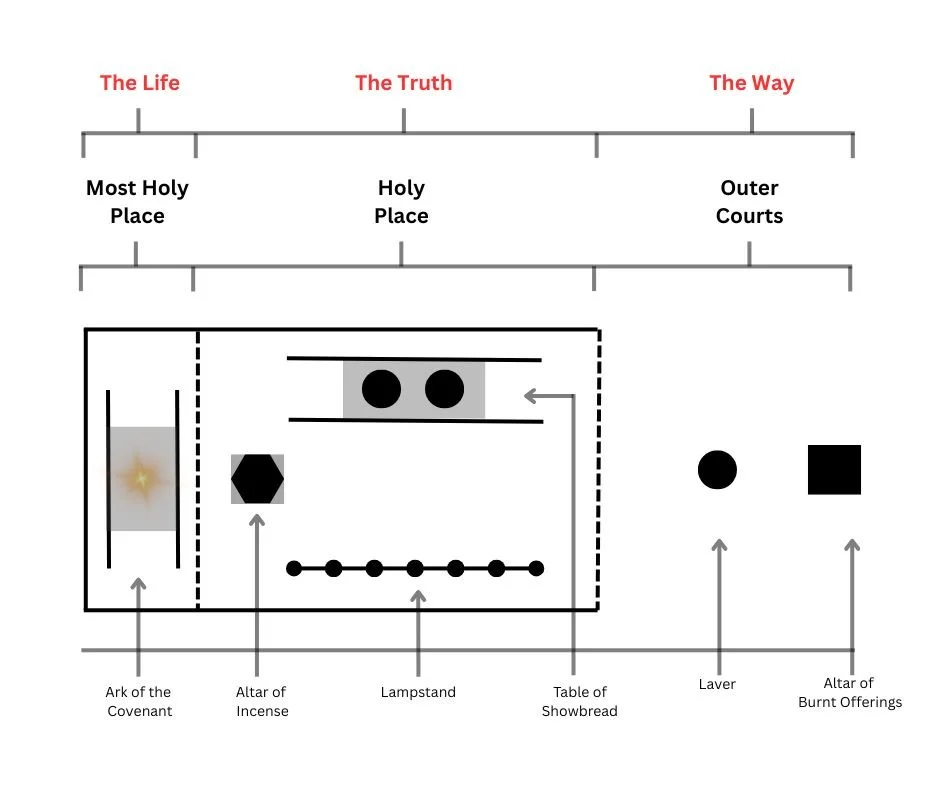
The way, the truth, and the life that Jesus talks about can be seen in the pattern of the tabernacle. The way is represented in the outer court furnishings, which consist of the altar of burnt offerings and the laver.
The Way
Jesus would ultimately make a way to the Father—God’s presence—through his death, burial and resurrection. Jesus’ death on the cross fulfilled the offering requirement priests had to make on the altar of burn offerings on behalf of themselves and Israel. Blood of unblemished male animals had to be offered to cover their sin. Jesus, the spotless Lamb of God, was offered as a living sacrifice on the cross to take away the sin of the world (John 1:29, 1 Peter 1:19). In the Sinai Covenant, offerings were made to cover people’s sin and to make priests ceremonially clean to stand before God. But Jesus’ blood—the New Covenant—completely removes sin from our conscience, or soul, to stand and serve before the living God (Hebrews 9:14).
The altar of burnt offerings was also means for Israel to become ‘right’ with God, which is known as justification. Through Christ’s resurrection from the dead, all who believe in Christ Jesus have been justified and declared righteous in God’s sight (Romans 4:25). The altar of burnt offerings was symbolic for the cross and Jesus, reconciling mankind back to the Father.
Then, the laver is symbolic for sanctification, meaning to be set apart. In the Old Testament, only the priests could use the laver to wash themselves to be set apart for service in the Holy Place. In Christ, we have been washed from our sins by his blood, and he has made us kings and priests to serve his God and Father (Rev. 1:5-6).
The Truth
God’s desire is also for all men to be saved and to come to the knowledge of the truth of who he is (1 Timothy 2:3). In the tabernacle, the truth can be seen in the Holy Place and its furnishings, as they were a reminder of God’s presence. Each one of the furnishings in the Holy Place of the tabernacle points to a truth of who Jesus is.
The lampstand had to be lit daily to bring light to the Holy Place. Jesus is the light of the world (John 8:12), and those who are in Christ are also a light of the world (Matthew 5:14).
The Table of showbread points to Jesus as the Bread of Life, as he is the provider and sustainer of life (John 6:35). We can also feast on the Bread of Life through his word, and also in remembrance in communion by partaking in the Lord’s supper at his table.
The altar of incense is where daily offerings were burned, creating a sweet, -pleasing aroma before God’s presence. This points to Christ as our mediator, who sits at the right hand of the Father always making intercession for us (Hebrews 7:25).
The Life
And last, but most importantly, is the ark of the covenant behind the veil in the tabernacle, as it represented God’s presence. Jesus is Immanuel—God with us (Matthew 1:23). And when Jesus died on the cross, the veil was physically torn in two (Matthew 27:51). This was a sign that the separation between God and man was finished, and because of Jesus’ blood, we can access the Most Holy place by a new and living way (Hebrews 10:19-20).
Jesus is the giver of life and life abundantly (John 10:10). Also, the ark of the covenant contained the Ten Commandments, or law. In the New Covenant—through Jesus’ death and resurrection—the law is now written upon our hearts and minds (Hebrews 8:10).
Christ has finished the work once required for his people to be in God’s presence, and we can enter into his rest (Hebrews 4).
Also, his work did not get rid of Israel, but it fulfilled the old covenants and extended salvation to the gentiles (Romans 11).
The Lord’s Table
Now, all those who have received Jesus as their savior can sit together at the Lord’s table—breaking the bread of his body and drinking the wine of his blood spilled out—in remembrance of what the Lord has done, so we could be reconciled to God.
His presence transforms his table into an extraordinary means of connection with each other and with God, the Father.
Works Cited
[1] “What were the Holy Place and the Most Holy Place in the temple/tabernacle?, January 27, 2026, https://www.gotquestions.org/Most-Holy-Place.html
[2] ‘The Plan of the Tabernacle (Exodus 26:1)’ illustration. Spirit-Filled Life Bible (NKJV). Third Edition. (2018). Thomas Nelson.
[3] Spirit-Filled Life Bible (NKJV). Third Edition. (2018). Thomas Nelson